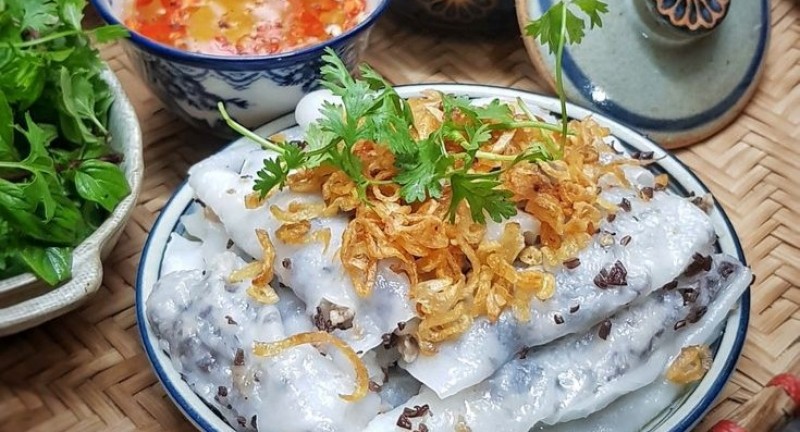
A Breakfast Classic Across Vietnam
Some dishes require patience to make well, and bánh cuốn is one of them. Watch an experienced cook prepare it and you'll see a kind of controlled precision that borders on performance: a thin pour of batter across a cloth stretched over steam, a few seconds of cooking, then a quick, practiced lift with a bamboo stick, and suddenly there's a translucent, silky rice sheet ready to be filled and rolled. It's quiet, repetitive, and oddly beautiful to watch. The result is one of Vietnam's most delicate breakfast dishes, light, fragrant, and satisfying in a way that heavier foods never quite are.
What Is Bánh Cuốn?
Bánh cuốn translates roughly to "rolled cake" or "rolled pancake." It consists of thin, steamed rice sheets filled with a savory mixture of minced pork and wood ear mushrooms, then rolled into soft tubes and topped with crispy fried shallots. The rolls are served with a warm, lightly seasoned dipping sauce (nước chấm) and a side of chả lụa (Vietnamese steamed pork sausage).
Unlike many Vietnamese dishes that are defined by bold, layered flavors, bánh cuốn is subtle. The rice sheets are barely seasoned on their own, their appeal is textural: silky, soft, and slightly sticky. The filling adds umami depth, the shallots add crunch and sweetness, and the dipping sauce ties everything together.

The Rice Sheets
Making the rice sheets is the hardest part of bánh cuốn and the skill that separates good vendors from great ones. The batter is made from rice flour, tapioca starch, and water, the tapioca starch is what gives the sheets their characteristic elasticity and translucency. The consistency needs to be almost perfectly liquid: thin enough to spread in an even layer, thick enough to hold together when lifted.
The cloth steaming method is the traditional approach. A piece of cloth is stretched tightly over a pot of boiling water, and the batter is poured onto it in a thin layer, then covered briefly. After just 30 - 60 seconds, the sheet is cooked. The cook uses a flat bamboo stick (or sometimes a wooden rod) to peel it off the cloth in a single motion and lay it flat. The filling goes on, the sheet is rolled, and the process starts again. Some modern stalls use a heated metal tray instead of cloth, which is faster but produces a slightly different texture. Traditional cloth - steamed bánh cuốn has a finer, more delicate quality that's worth seeking out.
The Filling
The filling inside the rolls is simple but carefully seasoned:
- Minced pork: The primary protein, cooked until just done and seasoned with fish sauce and pepper.
- Wood ear mushrooms (nấm mèo): Chopped finely. They add a subtle earthiness and a slight chewiness to the filling.
- Shallots: Sautéed briefly with the pork and mushrooms for fragrance.
The filling should be moist but not wet, too much liquid and it will soak through the delicate rice sheet. The balance is important.
The Toppings and Accompaniments
Hành Phi (Crispy Fried Shallots)
Scattered generously over the top of the rolls, crispy shallots add a necessary textural contrast to the softness of the rice sheets. They're sweet, slightly caramelized, and addictive on their own. A good bánh cuốn stall makes their shallots fresh daily.
Chả Lụa (Vietnamese Steamed Pork Sausage)
Sliced and served alongside the rolls, chả lụa is a mild, firm steamed sausage made from ground pork and starch. Its neutral flavor and bouncy texture complement the softness of the rolls and provide a more substantial protein element.
Nước Chấm (Dipping Sauce)
The dipping sauce for bánh cuốn is similar to the nước mắm pha used in many Vietnamese dishes but is typically slightly warmer and thinner in consistency. It's made from fish sauce, water, lime juice, sugar, and a little chili. Pour it over the rolls or dip each piece individually, both approaches work.
Rau Thơm (Fresh Herbs)
A small plate of fresh herbs, usually bean sprouts and some mint or perilla, arrives alongside. Add them to each bite for freshness.
Regional Variations
Hanoi Style
The original bánh cuốn comes from northern Vietnam, particularly the region around Hanoi and the northern provinces. The Hanoi version is characterized by its thin, almost translucent rice sheets and a relatively simple filling. It's served with nước chấm and chả lụa, and sometimes with chả quế (grilled cinnamon pork sausage) for extra flavor. The dipping sauce is warm rather than room temperature.
Southern Style
In Ho Chi Minh City and the south, bánh cuốn tends to be served with more accompaniments, bean sprouts, additional herbs, sometimes a fried egg on the side. The rolls themselves are similar but may be slightly thicker, and the dipping sauce is often sweeter to suit the southern palate.
Where to Try Bánh Cuốn
Hanoi
Bánh Cuốn Bà Hoành is one of the most famous bánh cuốn spots in Hanoi, and for good reason. The rice sheets here are exceptionally thin and silky, made by hand using the traditional cloth method. It's a family operation that's been running for decades, and the quality has remained consistently high.
- Address: 66 Tô Hiến Thành, Hai Bà Trưng, Hà Nội
- Hours: 7:00 AM - 12:00 PM
- Price: 35,000 - 55,000 VND
- Must try: Full set with chả lụa and chả quế
Bánh Cuốn Thanh Vân in the Old Quarter is another well - regarded option, slightly more central, good for visitors who are staying in that area.
- Address: 14 Hàng Gà, Hoàn Kiếm, Hà Nội
- Hours: 7:30 AM - 11:30 AM
- Price: 30,000 - 50,000 VND
Ho Chi Minh City
Bánh cuốn is less central to Saigon's food culture than it is in Hanoi, but you can find good versions at the markets and in residential neighborhoods. Look for stalls operating in the early morning, bánh cuốn is a breakfast dish everywhere in Vietnam, and most good stalls close by noon.
Practical Tips
- Arrive early. Most bánh cuốn stalls open at 7 or 7:30 AM and sell out within a few hours.
- Watch the cook work. If you have the chance to sit near the cooking area and watch the sheets being made, do it, it's genuinely impressive.
- Don't add too much dipping sauce at once. Start with a small amount drizzled over the top and add more gradually.
- Eat it fresh. Bánh cuốn softens and becomes less interesting as it sits. Eat it as soon as it arrives.
- Pair it with hot tea rather than coffee, the delicate flavors work better with a lighter beverage.
Bánh cuốn is patient food, made slowly and eaten gently. In a country where so many dishes are loud and intense, it offers something quieter and just as satisfying.